
“Runs great.” That’s what most listings say about a watch’s most important quality — whether the machine inside actually keeps time. We think you deserve a measurement, not an adjective. So before any watch is listed at Salt Flat Watch Co, it goes on a timegrapher, and the actual numbers go in the listing. Every watch. Every time. Here’s what that means.
What a Timegrapher Is
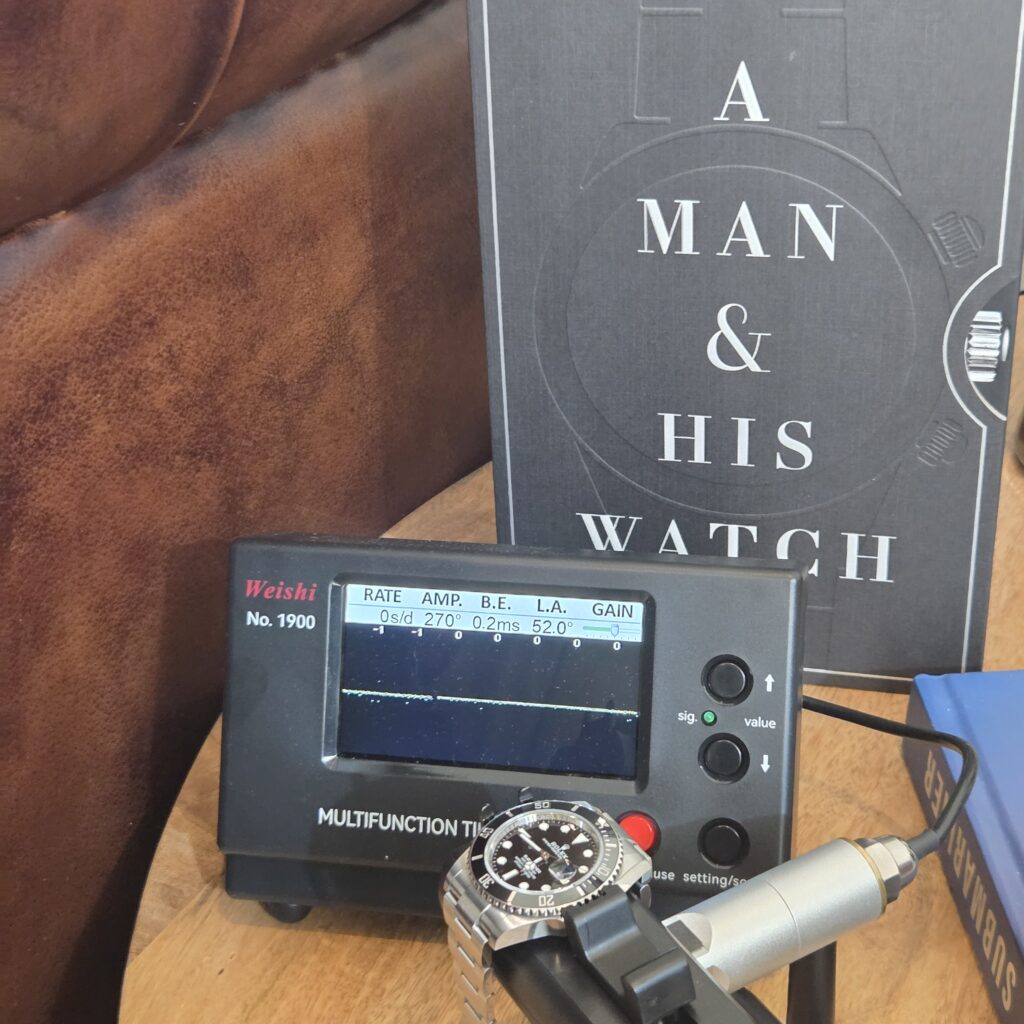
A timegrapher is a bench instrument with a very sensitive microphone. A mechanical watch ticks five to eight times every second, and each tick is the sound of tiny components doing exactly what a watchmaker designed them to do — or not. The timegrapher listens to those ticks for minutes at a time and turns what it hears into three numbers. Together, they’re a health report for the movement — the mechanical heart of the watch.
The Three Numbers (And What They Mean in Plain English)
Rate (seconds per day). How fast or slow the watch runs over 24 hours. For context: an officially certified chronometer is allowed to run between -4 and +6 seconds per day — that’s the standard Rolex, Tudor, Omega, and Breitling movements are held to. When our listing says a watch reads +2 seconds per day, that’s not “pretty good.” That’s certified-grade timekeeping, measured on our bench, shown in a photo.
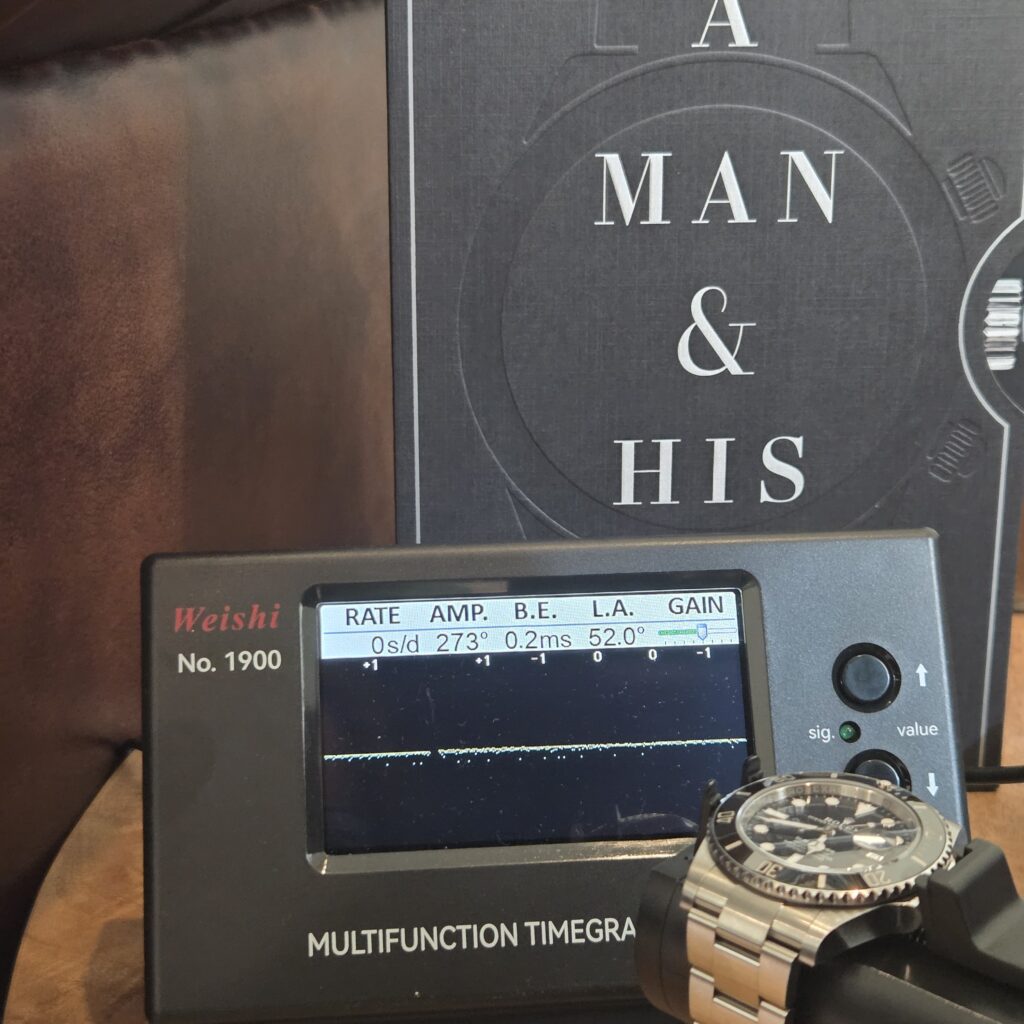
Amplitude (degrees). How strongly the balance wheel — the part that swings back and forth to keep time — is moving. Think of it as the movement’s pulse strength. A healthy movement typically swings between about 250° and 310° at full wind. Low amplitude can mean a watch is due for service even when it’s still keeping decent time — which is exactly why we measure it instead of guessing.
Beat error (milliseconds). Whether the tick and the tock are evenly spaced. A low beat error means the movement is running symmetrically, the way it left the factory. A reading of 0.0ms — which you’ll see on some of our watches — is as clean as this measurement gets.
The Detail Most Sellers Miss
Different movements need the timegrapher configured differently — a setting called lift angle. An Omega Co-Axial movement measures correctly at 38°. Most Valjoux-based chronographs, like Breitling’s Caliber 13, need 49°. Tudor’s in-house movements and most modern Swiss calibers use 52°. Set it wrong and the amplitude number is meaningless — and plenty of sellers never set it at all. Every reading we publish notes the movement was measured at its correct lift angle, chronograph disengaged, at full wind. Small details. That’s the point.
Beyond the Numbers
The timegrapher is the headline, but it’s one stage of a longer process every watch goes through before listing: authentication against its papers and serial, a full condition inspection under the bench light with every flaw photographed, function checks on the chronograph, bezel, and crown, and a gentle cleaning. Then the listing gets honest photos, the real numbers, and a plain-language description of anything we found.
Everything we sell is guaranteed 100% authentic.
A watch is a machine that makes a promise. Before we ask you to trust one, we measure whether it’s keeping it.
Every current listing includes its timegrapher reading — see them on the Watches page, or ask us anything at sales@saltflatwatch.com.
Timing is everything.